There are two ways your badge ends up on a garment, and they are good at different things. Most people have a vague preference for embroidery because it sounds more expensive, which is not the same as it being the right choice.
Here is how we decide.
Embroidery: stitched thread
The design is stitched into the cloth with coloured thread. It has real depth to it, it will outlast the garment, and it reads as the more permanent, more corporate option.
It suits: caps, beanies, polo shirts, fleeces, softshells, work jackets, aprons and bags. Anything structured or reasonably thick.
Where it struggles:
- Fine detail. A stitch has a minimum size. Hairline rules, thin lettering and the small print round the edge of a crest will fill in or drop out. As a rough guide, text much under 5mm tall is asking for trouble.
- Gradients and photographs. Thread comes in solid colours. A logo with a fade in it has to be redrawn as flat colours.
- Thin, stretchy, technical fabric. Stitching into a lightweight performance shirt pulls it out of shape — the cloth puckers round the design and it never sits flat again.
Print: applied to the surface
The design is applied to the face of the cloth. It handles detail and colour that thread simply cannot, and it adds no weight or stiffness.
It suits: squad numbers, player names, sponsor panels, large chest and back designs, anything with fine detail or a photograph in it, and any lightweight playing fabric.
This is why practically every football shirt you have ever seen has a printed number on it and an embroidered club crest. The two methods are doing the jobs they are each good at, on the same shirt.
Where it struggles: it sits on the surface, so over a long life and a lot of hot washes it will show more wear than stitching. On a match shirt that gets replaced every couple of seasons, that rarely matters. On a work jacket somebody wears every day for five years, it might.
A quick way to choose
| What you are branding | Usually |
|---|---|
| Club crest on a match or training shirt | |
| Squad numbers and player names | Print, always |
| Sponsor across the front or back | |
| Company logo on a polo or fleece | Embroidery |
| Cap, beanie or bucket hat | Embroidery |
| Work jacket or softshell | Embroidery |
| Hi-vis vest | Print — reflective fabric resists stitching |
| Bag, apron or towel | Either, depending on the detail in the logo |
| Anything with a gradient or a photo in it |
What each needs from your artwork
Both want the same thing: a clean vector file, or a large sharp image with a transparent background. Embroidery additionally needs the design simplifying to solid colours, which we do at our end.
If all you have is a crest pulled off a website or a photo of the club badge, say so — it is a very common starting point and usually fixable. See getting your logo print-ready.
See it before you commit
Whichever method a garment takes, the 3D designer shows your mark on that garment at its real printed width in millimetres, with the printable area drawn on. A beanie, for instance, puts your logo on the turned-up cuff rather than the crown — because that is where a beanie is actually decorated.
Not sure?
Send us the garment you have in mind and your logo and we will tell you which we would use and why. Workwear quote · Sports quote · sales@eastpointsports.net
More news
Our New Website Is Live: Teamwear, Workwear and a 3D Kit Designer
We have rebuilt eastpointsports.net from the ground up. Over 6,000 products, a 3D designer that shows your badge on the garment before you buy, squad list ordering, purchase orders, and free online shops for clubs and businesses.
Inside the Sports Range: Joma, Errea, Stanno and Chadwick
Over 2,500 lines of match kit, training wear, outerwear and equipment from Joma, Errea, Stanno and Chadwick, with more than 2,200 of them personalisable.
How Our 3D Kit Designer Works (And Why It Isn't a Flat Mockup)
Put your badge on a shirt and you see it on a 3D model you can spin, at its real printed size in millimetres, with the printable area drawn on the garment.
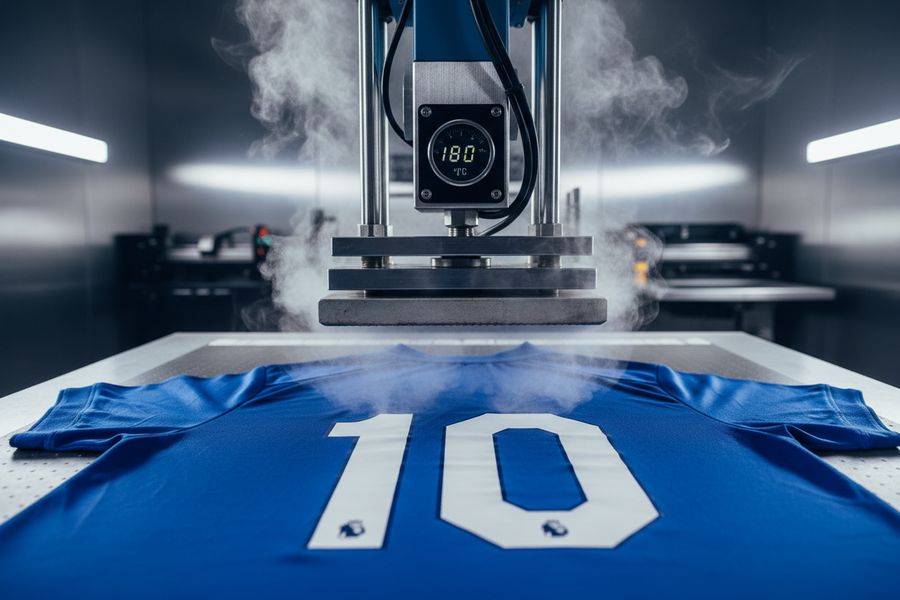
Names, Numbers and Logos: What Personalisation Costs
Every personalisation option is priced on the page, with no minimum order. Initials from £1.75 a letter, names from £0.80, logos at £3.95 flat.
Order a Whole Squad or Staff List in One Go
Paste your team sheet or staff list straight out of Excel and order every name, number and size in one basket, with one line per person on the order.
Pay on a Purchase Order: Schools, Clubs, Councils and Businesses
Enter your PO number in the basket and attach the PO document. It travels through to the order as a proper field, where your finance team expects it.